
Most savers struggle with the same tradeoffs: growth versus stability, income versus simplicity, and how to avoid high fees, concentrated bets, or tax-rule mistakes. Overall, the average dollar invested in U.S. funds earned 8.7% annualized over the 10 years ending 2025, according to Morningstar's Mind the Gap. That figure is not specific to Roth accounts, and your own results depend on what you hold and how you behave.
This guide covers five investment categories, how to compare them, and how to build a portfolio that shifts as retirement nears.
Key Takeaways
- A Roth IRA can hold stocks, ETFs, mutual funds, bonds, target-date funds, REITs, and CDs, depending on the custodian.
- Your goals, time horizon, risk tolerance, and costs decide the right mix.
- Broad funds simplify things; individual stocks, dividend picks, and REITs demand more research.
- Limits and rules change yearly, so verify current IRS guidance first.
What Is a Roth IRA and What Can You Invest in?
A Roth IRA is a tax-advantaged retirement account funded with after-tax dollars. Contributions aren't deductible, but qualified distributions can be tax-free. The account is the wrapper. The stocks, funds, and bonds inside are the investments.
What your custodian may offer
Menus vary by provider. Common choices include:
- Individual stocks and bonds
- Mutual funds and ETFs
- Target-date funds
- REITs and REIT funds
- CDs and money market options
IRS rules bar collectibles (with limited exceptions) and using IRA money to buy life insurance. Certain prohibited transactions can end the account's IRA status.
Why tax treatment matters
Dividends, interest, and capital gains generally aren't taxed as they accrue inside a Roth. Buying and selling within the account creates no taxable event. Unrelated business taxable income (UBTI) is a potential exception for some holdings.
A qualified distribution requires the five-tax-year period to be met, plus one of these: age 59½, disability, death, or the first-home exception (up to $10,000 lifetime).
Nonqualified withdrawals come out in order: regular contributions first, then conversions, then earnings. Earnings withdrawn early may be taxed and penalized.
Annual contribution caps still apply. For 2026, the IRS announced limits of $7,500, plus a $1,100 catch-up at age 50 or older. Income phase-outs begin at $153,000 for single filers and $242,000 for joint filers.

Best Roth IRA Investment Options for Different Investor Goals
These are five broad categories, not guaranteed rankings. Judge each on diversification, growth potential, income, volatility, costs, liquidity, and fit.
Diversified Stock Index Funds and ETFs
Broad U.S., international, or total-market funds hold many companies in one purchase. That makes them a natural core for long-term investors who want simplicity. ETFs also carry no share classes or front- or rear-load fees.
Costs are low. Broad index funds averaged a 0.09% expense ratio in 2025, against 0.32% for all U.S. funds and ETFs, per Morningstar's fee study.
Tradeoffs to watch:
- Market volatility still applies
- International holdings add currency risk
- Two funds may overlap heavily
- A narrow fund isn't truly diversified
- Sector or company-size tilts can build up quietly
Target-Date Funds
A target-date fund blends stocks, bonds, and other holdings, then shifts toward conservative assets as the date nears. It suits investors who want automation.
Know the limits:
- "To" funds stop shifting at the target date, while "through" funds keep going
- Glide paths differ by provider, so two 2050 funds can carry different risk
- The SEC notes these funds don't guarantee enough retirement income
- Rebalancing doesn't prevent losses, and underlying fund expenses vary
Individual Stocks and Dividend-Focused Funds
Growth stocks suit those seeking appreciation. Dividend payers and dividend funds appeal to those wanting income. But dividends aren't guaranteed. Per FINRA's guidance, companies may reduce or eliminate them.
Risks include:
- Company-specific problems
- Sector concentration
- Unsustainable payouts behind unusually high yields
- Ongoing monitoring needs
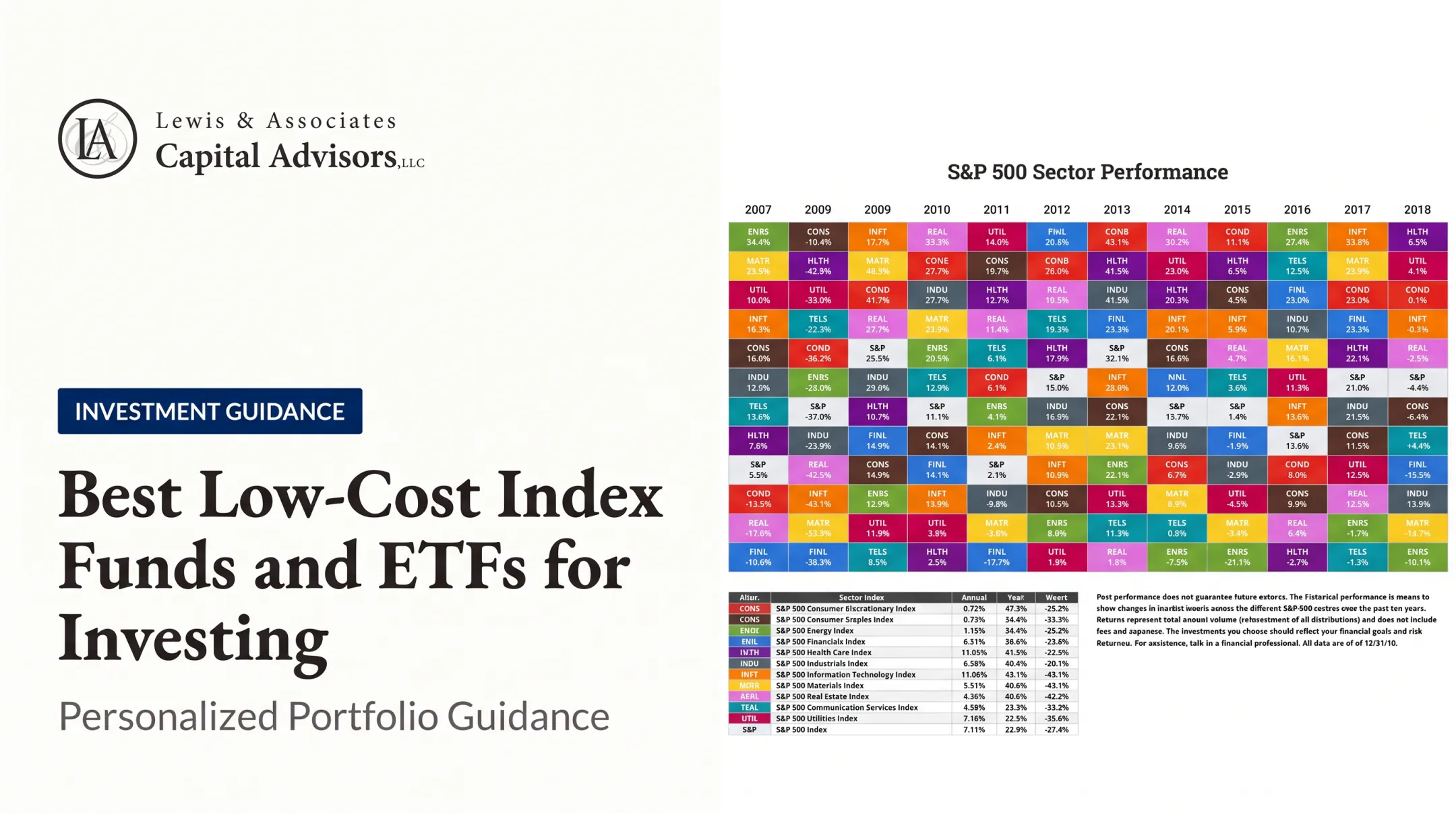
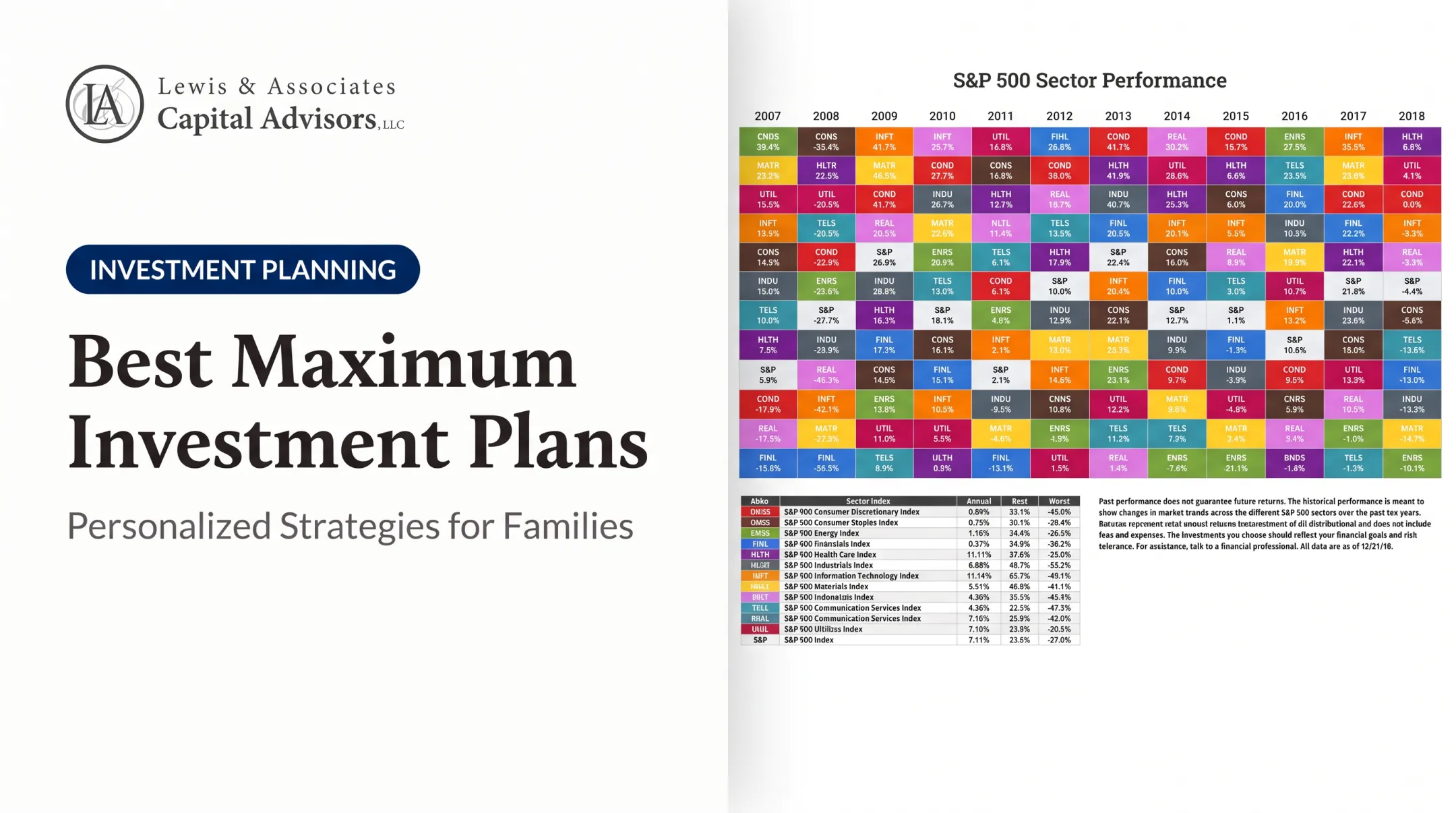
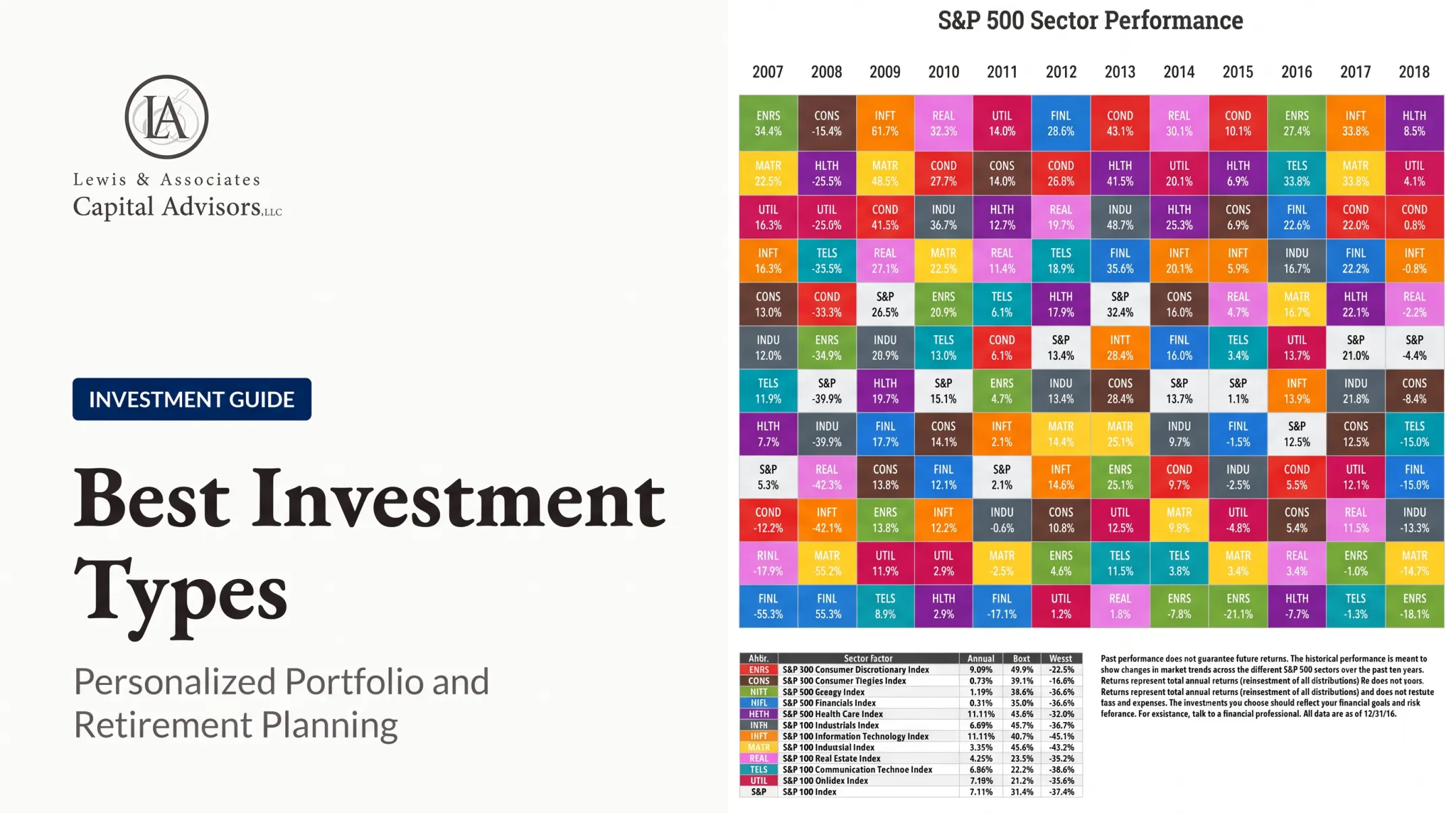
A diversified dividend fund spreads that risk. A handful of hand-picked stocks does not. Sector gaps matter too: the best and worst sectors have differed by more than 30% per year over the past decade or so.
Bonds, Bond Funds, and Cash Equivalents
Treasuries, investment-grade bonds, bond funds, money market funds, and CDs can supply income and stability. They suit people nearing retirement or with lower risk tolerance.
Lower volatility isn't zero risk:
- Interest-rate risk: bond prices generally fall when rates rise
- Credit risk: issuers can default
- Inflation risk: Vanguard's 1960 to 2022 data shows cash returned just 0.7% annualized after inflation, versus 6.3% for stocks and 2.0% for bonds
- Reinvestment and prepayment risk: proceeds may need to be reinvested at lower yields
FDIC coverage is generally $250,000 per depositor, per bank, per ownership category, and it applies to deposits like bank CDs, not to Treasuries, bonds, or money market mutual funds. CDs also carry early-withdrawal penalties set by contract.
REITs and Other Income-Producing Assets
REITs generally must distribute at least 90% of taxable income, so they throw off sizable income. Inside a Roth, that income isn't taxed annually, which is why investors consider them. Tax treatment still varies, and it isn't a reason to ignore risk.
Consider:
- Real-estate concentration and property-sector exposure
- Interest-rate sensitivity, though history is mixed: REITs beat the S&P 500 in 43% of rising-yield episodes from 1992 to mid-2025, per Nareit
- Fees and liquidity, especially for non-traded REITs, which can limit redemptions and carry high upfront costs
- A diversified REIT fund versus a single company

How to Choose and Build a Roth IRA Portfolio
Start with purpose and risk
Decide what the money is for. A multi-decade retirement horizon calls for a different mix than an earlier goal, a legacy plan, or near-term income.
Then separate risk tolerance (how you feel about drops) from risk capacity (what you can afford). Consider income stability, emergency savings, other accounts, and expected withdrawals.
A 30% loss followed by a 30% gain leaves a $100,000 account at $91,000, and it needs another 9.89% to recover.
Set the allocation, then pick holdings
Set your asset allocation first. Then build a diversified core, and add limited satellite positions if you want them. This prevents duplication and keeps one company, sector, or asset class from dominating.
Compare costs
Review the full cost stack before you buy:
- Expense ratios and advisory fees
- Trading costs, turnover, and bid-ask spreads
- Account charges
The SEC's fee example shows how fees compound against a portfolio. Still, the cheapest fund isn't right if it doesn't fit your plan.
Three hypothetical profiles
These illustrate emphasis, not personal recommendations.
| Profile | Likely emphasis | Likely lighter |
|---|---|---|
| Long-term growth | Diversified stock funds, possibly a few satellite stocks | Bonds, cash |
| Balanced accumulation | Stock funds or a target-date fund, plus bond funds | Single stocks, REITs |
| Retirement-income preparation | Bonds, cash equivalents, dividend funds | Concentrated stock positions |
Automate and maintain
- Automate monthly contributions. Dollar-cost averaging can lower your average purchase price, though results aren't guaranteed.
- Reinvest eligible distributions.
- Review after marriage, a job change, or a new child.
- Rebalance when your mix drifts. The SEC cites six- or 12-month intervals or percentage thresholds, and some studies show a slight edge at 12 to 18 months.
For a growth illustration, use the Investor.gov compound interest calculator and state your own assumptions. Returns are never guaranteed.

How We Chose the Best Roth IRA Investment Options
We compared each category on:
- Diversification and long-term return potential
- Volatility and income characteristics
- Tax treatment and liquidity
- Fees and accessibility
- Research and monitoring required
Common mistakes
- Chasing recent performance. S&P's SPIVA scorecard finds consistent outperformance hard to sustain.
- Buying on yield alone. High distributions can mask weak total return or principal risk.
- Overlooking fund overlap. Several funds may stack the same holdings and sector bets.
- Holding too much cash. Excess cash drag works against long-term Roth growth.
- Assuming a Roth wipes out all taxes. Early withdrawals and certain income can still trigger taxes or penalties.
Verify current fund prospectuses, IRS rules, and regulatory guidance before acting. No category suits every investor.
Conclusion
The best Roth IRA investment is the one that supports your objectives, time horizon, risk capacity, and tax strategy, not the one with the highest recent return.
Before deciding, review:
- Diversification and fees
- Contribution eligibility
- Withdrawal rules
- Beneficiary designations
Talk to a tax professional about tax-specific questions.
If you'd like individualized guidance, Lewis & Associates Capital Advisors, LLC is a North Carolina-registered fiduciary investment adviser. The firm offers commission-free wealth and retirement planning, personalized portfolio strategies, and ongoing management from offices in Holly Springs and Raleigh.
Investing involves risk, including loss of principal, and no strategy is assured to meet its objectives. Contact the firm at 984-225-4044 for a review of your retirement strategy.
Frequently Asked Questions
What can you invest in in a Roth IRA?
Common choices include stocks, bonds, mutual funds, ETFs, target-date funds, REITs, and CDs. Available options depend on your custodian, and IRS rules restrict holdings such as collectibles.
Can I open a Roth IRA if I make $200,000 a year?
It depends on MAGI, filing status, and tax year. For 2026, a single filer at $200,000 is above the $168,000 direct-contribution limit; joint filers are still below the $242,000 phase-out start. Backdoor conversions may still be possible with tax guidance.
When can I withdraw money from my IRA?
You can generally withdraw Roth contributions anytime without tax. Earnings are qualified after the five-year period and age 59½ or another qualifying event. Exceptions and penalties can apply.
Is $200 a month enough for a Roth IRA?
It can be a strong start, but “enough” depends on your goal, timeline, existing savings, returns, and other income. Run a personalized projection instead of relying on a universal target.
What are the top 5 investments for a Roth IRA?
Common building blocks are diversified stock funds or ETFs, target-date funds, individual stocks or dividend funds, bonds or other fixed income, and REITs. Weight them to your horizon and risk tolerance.
What is a good portfolio for a Roth IRA?
A good portfolio is diversified and matches your time horizon, risk tolerance, retirement needs, fees, and other accounts. Review and rebalance it as circumstances change.