
Introduction
Picking an investment firm is a bigger decision than picking a fund. You're choosing how much control you keep, how much advice you get, and who answers the phone when markets drop.
The confusion starts with the label. A low-cost brokerage, a robo-advisor, an asset manager, and a fiduciary advisor can all be called an "investment firm," yet their fee structures and obligations differ.
U.S. households have a lot at stake: ICI's 2026 Fact Book reports 76.0 million households owning registered funds in 2025.
This article compares five firms for different investor profiles, then shows how to judge fiduciary status, services, fees, investment choices, minimums, and long-term fit.
Key Takeaways
- The best firm depends on your goals, account size, and how much guidance you want.
- Compare total cost: advisory fees, fund expense ratios, minimums, and platform charges.
- Fiduciary status and clear disclosures matter more than brand size.
- Pre-retirees and 401(k) rollover clients often need personalized planning, not a platform alone.
Overview of Investment Companies and Firms in the U.S. Market
Each category does a different job:
- Brokerage firms: execute trades; recommendations fall under Regulation Best Interest.
- Mutual fund and ETF companies: run pooled funds.
- Robo-advisors: automated advisory programs that build and manage a portfolio from your answers.
- Registered investment advisers (RIAs): give advice for a fee; "wealth manager" is a common alternate name.
- Investment banks: underwriting and M&A work, so not relevant to retail investors.
Size is not quality. The SEC counts 16,413 registered advisers, and ICI puts U.S. registered investment company assets at $45.1 trillion at year-end 2025. Those numbers describe the market, not who serves you best.

The firms below aren't interchangeable. Some suit self-directed or automated investors, while others provide human advice and customized portfolios.
Best Investment Companies and Firms in the U.S.
Each firm is compared on service model, fiduciary or regulatory structure, investment access, planning depth, transparency, fees, minimums, digital tools and investor fit.
Lewis & Associates Capital Advisors, LLC
Lewis & Associates is an independent registered investment adviser founded in 2009 by Steven Kent Lewis, with offices in Holly Springs and Raleigh, North Carolina. It describes itself as an advisory firm, not a brokerage, and offers commission-free investment wealth and fiduciary services.
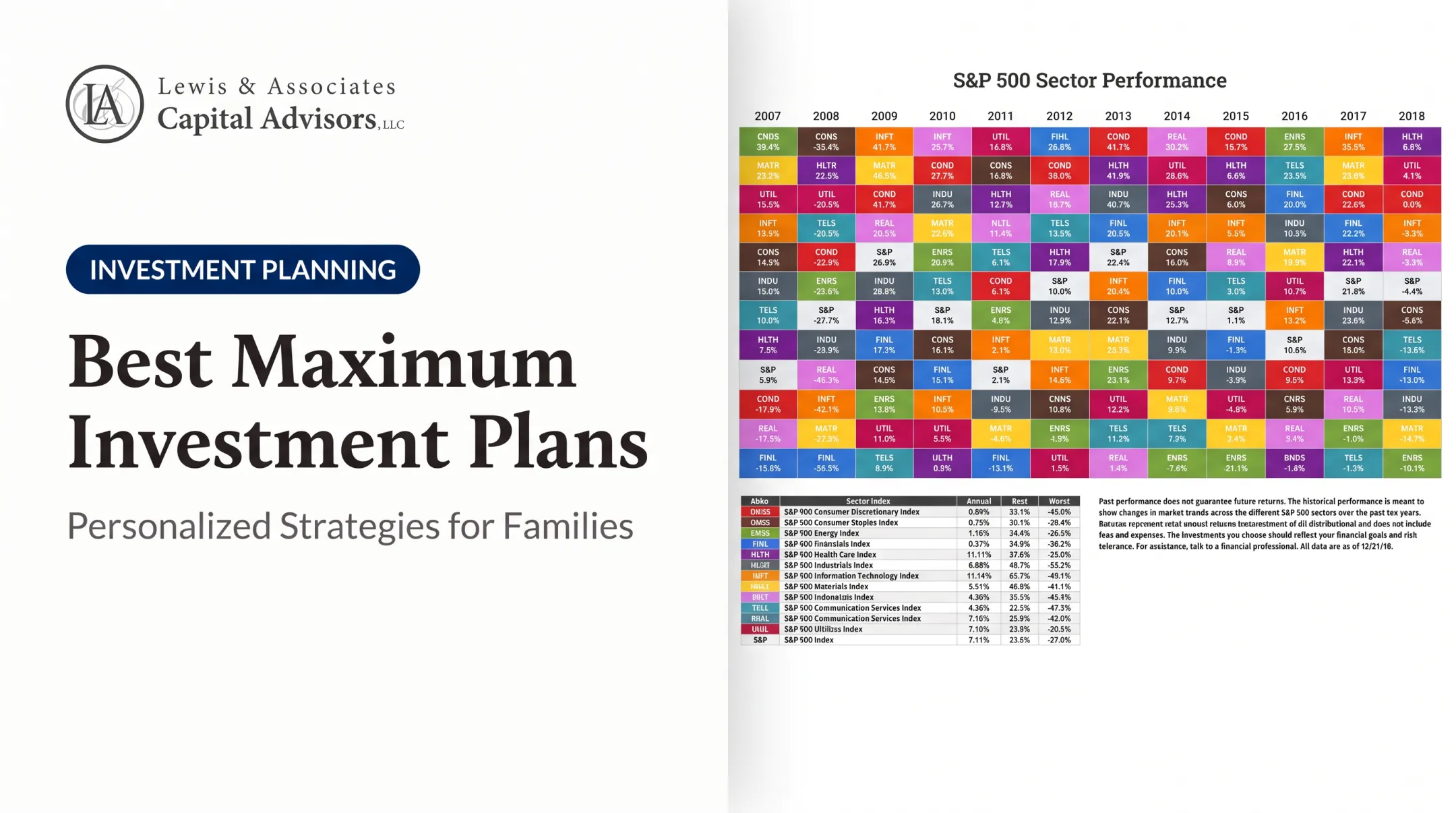
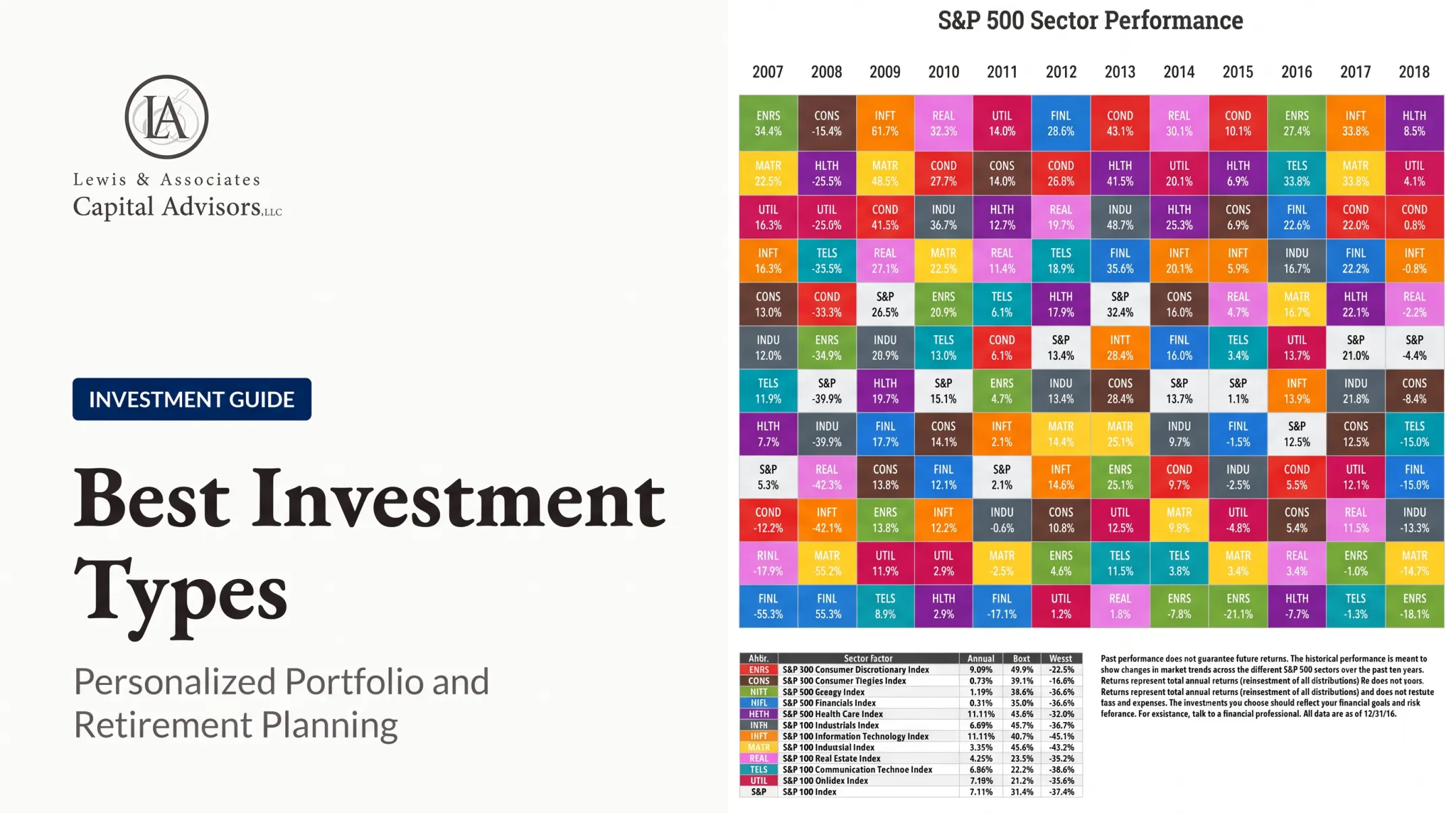
Its approach is active and sector-driven. It monitors the 11 S&P 500 sectors, uses stop and trailing-stop orders, and can raise cash positions during volatility. Fiduciary duty applies to its investment advisory advice, not to insurance or broker-dealer services.
| Details | |
|---|---|
| Best suited for | Pre-retirees, retirees, 401(k) rollover clients, small business owners, plan sponsors, and hands-on investors in North Carolina |
| Approach | Active management, retirement income planning, individual stocks and bonds, annuity guidance, SEP/SIMPLE and 401(k) plans |
| Due diligence | Registered in North Carolina (CRD 157971); Steven Lewis holds the CFS® designation; review Form ADV Part 2 for fees and minimums |
Pricing is a monthly fee based on assets under management. Ask the firm for the exact schedule and minimums.
Fidelity Investments
Fidelity offers a broad platform: brokerage, retirement accounts, funds, planning and advice. Online U.S. stock and ETF trades cost $0, and there is no minimum to open a brokerage account, according to Fidelity's commission page.
Fidelity Go, its robo service, charges $0 below $25,000 and 0.35% at $25,000 and above, with coaching calls at that level. Its fit is strongest for investors who want one place for self-directed and optional managed investing. Investors who want a dedicated advisor and a customized portfolio will need options beyond its basic offerings.
| Details | |
|---|---|
| Best suited for | Self-directed investors and those comparing optional managed advice |
| Approach | Self-directed, fund-based, automated and coaching models; not every service comes with every account |
| Cost and access | Some non-Fidelity funds carry a $49.95 short-term redemption charge; confirm current fees |
Charles Schwab
Schwab pairs self-directed control with managed options. Online U.S. stock and ETF trades are $0, with no minimum for individual brokerage accounts.
Schwab Intelligent Portfolios requires $5,000 and charges no advisory fee, though ETF expenses and cash-allocation costs remain. Schwab Wealth Advisory requires $500,000 and starts at 0.80%. Pricing and service vary a lot by program.
| Details | |
|---|---|
| Best suited for | Hands-on investors, retirement savers, and households comparing hybrid models |
| Approach | Stocks, bonds, funds, ETFs, managed portfolios and planning support |
| Cost and access | Other mutual fund purchases can cost up to $74.95; check each program's requirements |
Vanguard
Vanguard is known for low-cost index funds, ETFs and long-term investing. Its homepage cites a 0.07% average fund expense ratio, while a March 2026 article cites 0.06%. The two figures use different definitions, so verify the one that applies to your funds.
It fits diversified, passive investors. It is a weaker match for people who want individual security selection, frequent trading tools or highly individualized planning.
| Details | |
|---|---|
| Best suited for | Long-term passive investors and retirement savers |
| Approach | Index funds, ETFs, target-date funds, Digital Advisor, Personal Advisor Select |
| Cost and access | Digital Advisor needs $100 and costs up to 0.25% gross; Select needs $500,000, capped at 0.30% plus fund expenses |
Betterment
Betterment is an automated, goal-based robo-advisor with automatic rebalancing. Digital has no required balance and costs $5/month, or 0.25% once you reach $24,000 in household balance or $200 or more in monthly recurring deposits.
Premium requires $100,000 and charges 0.65% on the first $1 million, with access to CFP professionals. Complex tax, estate, business or individual-security needs may outgrow it.
| Details | |
|---|---|
| Best suited for | Hands-off investors who prefer digital tools |
| Approach | Algorithm-built portfolios, goal setting, auto-rebalancing, human advice on Premium |
| Cost and access | Premium eligibility depends on household investments; ongoing pricing is separate from 401(k) rollover help |

How We Chose the Best Investment Companies and Firms
"Best" isn't universal. A common mistake is choosing on brand, advertising or a low trading cost without checking that the service model fits your goals.
Regulation and fiduciary duty
Advisers owe a fiduciary duty of care and loyalty. Brokers follow Regulation Best Interest, and disclosure alone doesn't satisfy it.
Look up any firm through Investor.gov's Ask and Check: IAPD for advisers, BrokerCheck for brokers. Read Form ADV and Form CRS for services, fees and conflicts.
Disciplinary history is worth reading. The SEC settled with Schwab subsidiaries ($187M, 2022), Betterment ($9M, 2023) and Vanguard ($106.41M, 2025). These are selected historical actions, not a safety ranking.
Total cost
- Advisory or management fees
- Fund expense ratios (ICI averages: equity mutual funds 0.40%, index equity ETFs 0.14%)
- Commissions and transaction fees
- Account minimums and platform charges
Flexibility and fit
Confirm the firm supports the accounts and planning you need:
- Individual stocks, bonds, funds and ETFs
- Rollovers and employer plan support
- Retirement income planning and tax coordination
Rollovers deserve scrutiny: an IRA can cost more than a former employer's plan, so compare before moving.
Test fit in an initial consultation and in writing. Past performance is no guarantee of future results, and all investing risks loss of principal. Review current disclosures and consult a registered professional before deciding.

Conclusion
The strongest firm is the one whose services, philosophy, fees, and communication match your goals, not necessarily the biggest name. Compare these factors before you commit:
- Total costs and fee structure
- Fiduciary status
- Account minimums
- Investment options
- Advisor access
- How the firm adjusts your plan as life changes
If you want a personalized, actively managed investment or retirement roadmap, contact Lewis & Associates Capital Advisors, LLC at 984-225-4044 to discuss whether its fiduciary services and North Carolina practice fit. No outcomes are promised.
Frequently Asked Questions
What are the top 5 investment firms?
There's no universal top five. This article features Lewis & Associates (personalized active management), Fidelity (all-in-one platform), Schwab (hybrid), Vanguard (passive, low-cost) and Betterment (automated). Verify current disclosures.
How much does an investment firm charge?
Common models include asset-based advisory fees, flat or subscription fees, fund expense ratios and commissions. Some programs also have account minimums. Costs vary by firm and service.
Is $500,000 enough to work with a financial advisor?
It meets some minimums, such as Schwab Wealth Advisory and Vanguard Personal Advisor Select, but not every firm's. Confirm eligibility, fees and service scope directly with each advisor.
What is a social investment?
Social or ESG investing allocates capital using environmental, social and governance criteria. Screening methods, risks and products differ by fund and manager.
What are the 7 types of investments?
Common categories are stocks, bonds, mutual funds, ETFs, real estate, cash equivalents and alternatives. Risk, liquidity and taxes vary by investor.